
by Mia Taylor
Last updated: 7:00 PM ET, Tue June 2, 2026
Nearly 15 years ago, I went on a solo trip to Peru, hiking through the Andes to Machu Picchu. Much to my surprise, many of the other travelers I met along the way were shocked that I was making the trip alone.
Couples and individuals traveling with friends regularly approached me to question my solo travel status and were simply mystified by my decision to embark on a trip without a plus one. The choice had seemed perfectly natural to me. And to be clear, I was traveling with a tour operator, G Adventures. But I was the only solo woman in the group.
The looks of bemusement I received throughout this trek, along with the steady stream of questions from complete strangers, eventually made me feel like I must indeed be unusual for taking such a trip without a companion in tow.
Fast forward to 2020 and beyond and numerous reports and studies have since established that I wasn’t so unusual after all. There are legions of travelers just like me, who find it perfectly acceptable, or even preferable, to explore the world on their own. (And as a side note, many of them are women over 50.)
In fact, 2026 has seen the largest increase in interest in solo travel ever, with 1.6 million searches of “solo travel” during the month of January alone, according to The Luxury Solo Travel Report just issued by safari company Go2Africa.
Based on an analysis of Go2Africa’s proprietary customer data, along with third-party search data, the report also shows that searches for solo travel terms have increased 230% in 10 years, with the highest searches around travel tips, female solo travel and group solo travel.
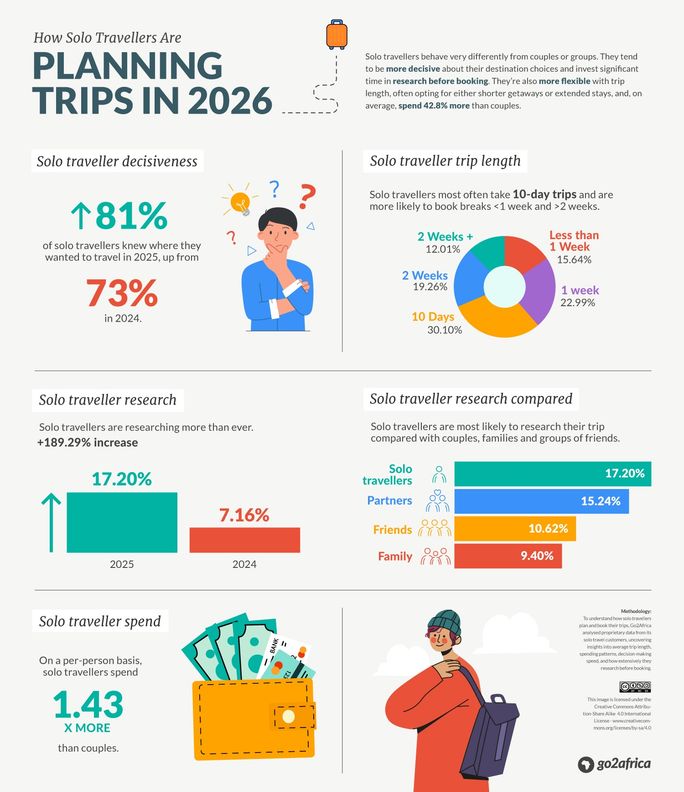
New data reveals that solo travel is more popular than ever. (Photo Credit: Courtesy Go2Africa)
Also noteworthy: There’s serious money to be made by catering to solo travelers. In the U.S. alone, the solo travel market was valued at $95 billion in 2024 and is expected to reach over $190 billion by 2030, according to separate data published by Research and Markets.
Clearly, as the Go2Africa report points out (and what I’ve personally known all along) “solo travel is more than just a fad.”
“More and more people every year are choosing to travel alone, whether to have ultimate freedom over their itinerary, to push themselves into new experiences or because their family and friends can't travel as flexibly as they can,” says the Go2Africa report.
Here are some of the additional solo travel highlights from the Go2Africa report:
- In the United States, the highest current searches for ‘solo travel' happened in June of 2025. However, this accomplishment is expected to be beaten in June 2026 with monthly searches predicting to reach over 8,000
- Search interest was strongest in a number of states, including North Dakota, Vermont, and Arkansas.
- On a per-person basis, solo travelers actually outspend couples, spending 42.8% more on average.
- 30.1% of solo travelers prefer to travel for roughly 10 days.
- Solo travelers are more intentional in their planning, often researching their trips in advance and arriving with a clear destination in mind.
- Solo travelers are a highly decisive group, with 81.18% having a clear idea of where they want to go before booking a trip. This is up from 72.83% in 2024.
(Photo Credit: Courtesy AdobeStock)
Solo Travelers Emerge as Fastest-Growing Safari Segment
While solo travelers can be found exploring the world in many different ways, internal data from Go2Africa reveals that this demographic is especially interested in pursuing safaris. In fact, solo globetrotters were the only type of traveler to show an increase year-on-year within Go2Africa's customer base, rising from 13% of inquiries in 2024 to 15.42% in 2025.
“Every other demographic, including couples, families, and groups of friends saw a nominal decrease in representation, not hinting at a lack of interest, but more so that solo travelers are starting to take over the luxury safari sector,” says the report.
And there's yet another interesting takeaway from the Go2Africa analysis. Solo travelers from the United States make up the biggest number of globetrotters interested in safaris. They amounted to more than 50% of Go2Africa’s customers. Moreover, there was a 26.26% increase in this customer segment for Go2Africa between 2024 to 2025.
“Not only is the U.S. the dominant source market for solo travel, but it is also one of the fastest-growing, reinforcing its position as a key driver of demand,” says the report.
For the latest travel news, updates and deals, subscribe to the daily TravelPulse newsletter.
Topics From This Article to Explore


