
by Mia Taylor
Last updated: 3:05 PM ET, Tue June 2, 2026
Summer is not exactly the most budget friendly time to visit Western Europe. School’s out. Families are traveling. It’s peak season and prices shoot up.
The U.S.-Israel attack on Iran has only exacerbated that situation for summer 2026, by causing a global shortage of jet fuel oil (amid the closure of the Strait of Hormuz). That, in turn, has caused the cost of airline tickets to skyrocket.
Peak summer fares to to places like Paris, Rome, Barcelona, and London are running $1,700 to $2,100 roundtrip. That’s roughly 20% higher than last summer.
But if you’ve been daydreaming about a summer getaway to Europe (raising hand), all is not lost.
According to a new analysis conducted by Dollar Flight Club, there are about 10 European cities where summer flights can still be found for $570 or less.
“There’s still some opportunity to get to Europe on a budget right now if you know where to look,” says a new Dollar Flight Club report. “Cities with fares in the $350-$570 range...actually have fewer crowds and flights that cost a third of what you’d pay to major spots.”
While domestic fares are up 10%-15% across the board for summer and transatlantic flights to the big cities have increased the aforementioned 20%, it seems there are pockets of Europe where fares are only up 5-10%, or in some cases haven’t moved much at all.
So, what cities are we talking about exactly? Here’s a closer look at some of the cheapest prices currently available for travel to Europe this summer.
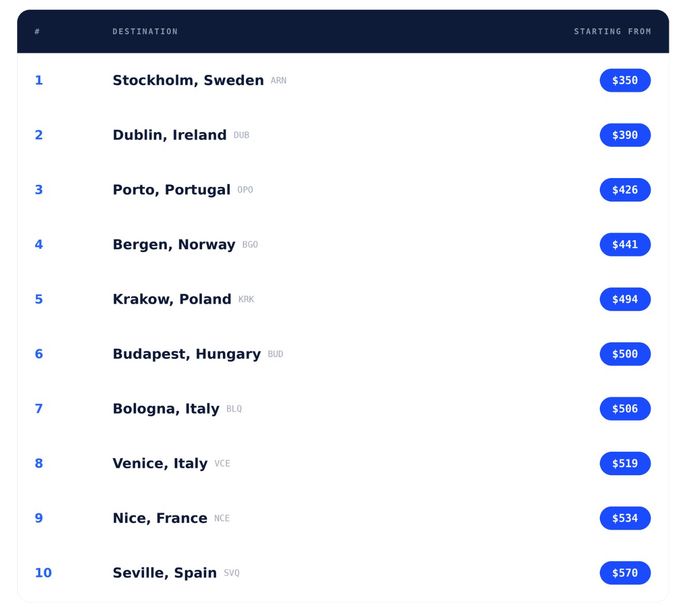
Costs to fly to some European cities have shot up 20% this summer, but there are still some deals to be had. (Photo Credit: Courtesy Dollar Flight Club)
- Stockholm, Sweden: $350
- Dublin, Ireland: $390
- Porto, Portugal: $426
- Bergen, Norway: $441
- Krakow, Poland: $494
- Budapest, Hungary: $500
- Bologna, Italy: $506
- Venice, Italy: $519
- Nice, France: $534
- Seville, Spain: $570
Factors Driving Affordability
Now, let's talk about why these cities remain more affordable. It boils down to a variety of factors, according to Dollar Flight Club. Among them: Shorter flight distances from the United States, low-cost carrier competition on some routes and in the case of northern routes, more fuel efficient aircraft.
"The expensive cities are expensive for a reason. They're farther, they burn more fuel, everyone wants them, and airlines know it. The cities on our list are the opposite," Jesse Neugarten, CEO and founder of Dollar Flight Club told TravelPulse today.
"They're closer, so less fuel per seat," Nuegarten explained. "They've still got low-cost carriers competing, which keeps the big airlines from jacking up prices. And honestly, most Americans aren't even searching Krakow or Porto, they're all looking at Rome and Paris. Less demand for those seats means the fares stay cheap. That's the whole reason you can still get to Europe this summer for under $570 instead of $2,000."
Let's break down what Neugarten said even further.
-Shorter flight distances. Dublin’s 3,200 miles from New York. Paris is 3,625. Rome is 4,280. That difference matters when fuel prices spike, says the Dollar Flight Club report. “Shorter routes burn less fuel per seat, so airlines can keep fares lower and still make money,” explains the report. “Northern European cities have a built-in advantage right now because they’re just closer.”
-Low-cost carrier competition. Dublin, Stockholm, and Porto all have strong low-cost carrier service. “These airlines compete on price, not on premium cabins or loyalty programs,” the report explains. “When legacy carriers try to jack up fares, low-cost carriers undercut them.” What does that mean for you, the traveler? The low cost carrier competition effectively keeps a lid on pricing even during times when a geopolitical crisis (like what’s currently taking place Iran) is making fuel expensive. The big Western European hubs have less low-cost competition, so legacy carriers can push prices up.

A young woman enjoying her trip to the Castle of Budapest (Photo Credit: Spectral-Design/Adobe Stock)
-Americans underestimate Eastern Europe. Krakow and Budapest are world-class cities but most Americans searching for Europe aren’t typing those into Google Flights, suggests the Dollar Flight Club report. Instead, Americans are busy searching for more well-known locales like Rome, Paris, Barcelona. But that’s the traveler’s loss because lower search volume means lower demand pressure for secondary European cities. And airlines, of course, price tickets based on demand. “If nobody’s fighting over the seats, fares stay reasonable,” the report explains.
-Secondary city strategy. Another valuable tip courtesy of Dollar Flight Club: Bologna, Porto, Nice, Venice are all alternatives to bigger hubs. “And airlines know if they price Bologna at $1,500, everyone will just fly to Rome and take a train so they price it lower to fill the plane,” says Dollar Flight Club. “It’s the same reason Newark’s often cheaper than JFK. Less prestige and more competition for passengers."
-Fuel-efficient aircraft on Northern routes. Last but hardly least, many of the Northern European cites that made the list of least expensive destinations are being serviced by newer, fuel-efficient planes, according to Dollar Flight Club. And guess what? Airlines deployed their most efficient aircraft on the routes where fuel costs would hit hardest. That means better per-seat economics and more ability to discount fares.
For the latest travel news, updates and deals, subscribe to the daily TravelPulse newsletter.
Topics From This Article to Explore


